SKY QUALITY METER (WIP)
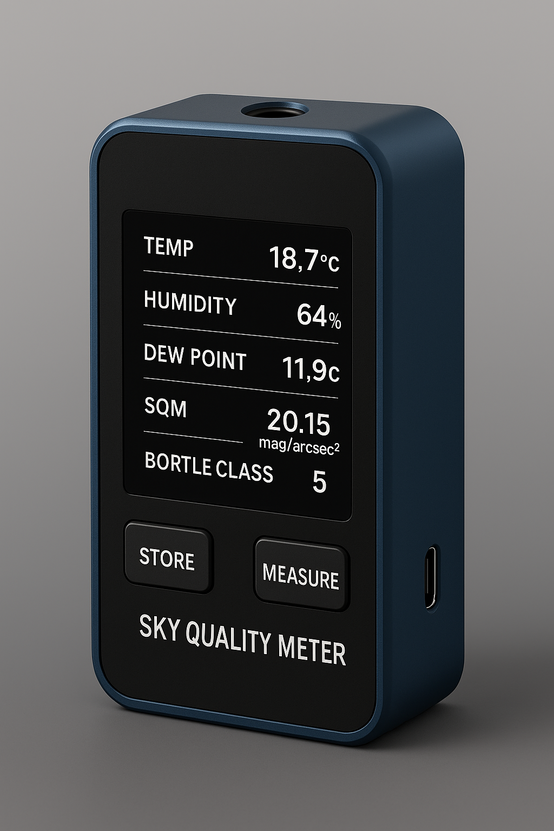
Sky Quality Meter project prototype on the Raspberry Pi 3 B+.
The Sky Quality Meter is a compact, field-deployable instrument designed to accurately quantify the darkness of the night sky. It provides objective, repeatable measurements for astrophotography planning, site evaluation, and long-term monitoring of light pollution trends.
At its core, the device integrates a high-sensitivity TSL2591 ambient light sensor connected to a Raspberry Pi 3 B+ via the I²C interface. The sensor simultaneously measures broadband and infrared light, automatically adjusting gain and integration time to maintain precision across a vast dynamic range—from bright twilight to deep-sky conditions.
Each measurement cycle consists of ten consecutive samples, averaged to suppress noise and ensure stable output. Results are provided in lux and magnitudes per square arcsecond (MPSAS), the standard photometric unit for sky brightness. Conversion from lux to MPSAS follows the established relation between luminance and astronomical surface brightness. A fine user-defined offset calibration allows inter-device consistency or matching against reference instruments.
Optical Design
The instrument employs a 25° field of view to sample a representative portion of the sky while minimizing local light contamination. This is achieved through a matte-black optical tube, 60 mm in length with a 26 mm aperture, incorporating knife-edge baffles to eliminate internal reflections. The sensor is mounted behind an optical glass window or UV-filter plate, providing dust and moisture protection. All internal surfaces are treated with ultra-flat black paint or flocking material for maximum light absorption. The device is intended for zenith pointing during operation.
Electronics and Power
The system is powered by a 5 V / 3 A USB supply, with low consumption enabling long sessions on battery packs during remote use. Standard Raspberry Pi 3 B+ I²C wiring is used:
- Pin 1 (3V3) → VDD
- Pin 6 (GND) → GND
- Pin 3 (GPIO 2 SDA1) → SDA
- Pin 5 (GPIO 3 SCL1) → SCL
Data Processing and Interface
The Raspberry Pi manages sensor operation, temperature compensation, data logging, and communication. Measurements can be initiated manually, scheduled at fixed intervals, or run continuously. Each record includes UTC timestamp, temperature, humidity, and optional GPS coordinates if auxiliary modules are attached.
A future lightweight web interface will allow remote visualization and control through local Wi-Fi or network connection. A small integrated display provides live feedback, showing temperature, humidity, dew point, SQM value, and Bortle class estimation.
Calibration and Accuracy
Calibration is performed against a verified reference SQM device under identical conditions. Both units are placed at zenith during multiple moonless nights, with averaged results used to determine a fixed calibration offset. Target measurement precision is ±0.10 mag arcsec⁻² after calibration.
Purpose and Outcome
This project will demonstrate that high-precision sky brightness measurements can be achieved using affordable, open-source hardware. The final product will be a robust, anodized-aluminum Sky Quality Meter—portable, accurate, and adaptable for both permanent observatory installations and mobile astrophotography operations.