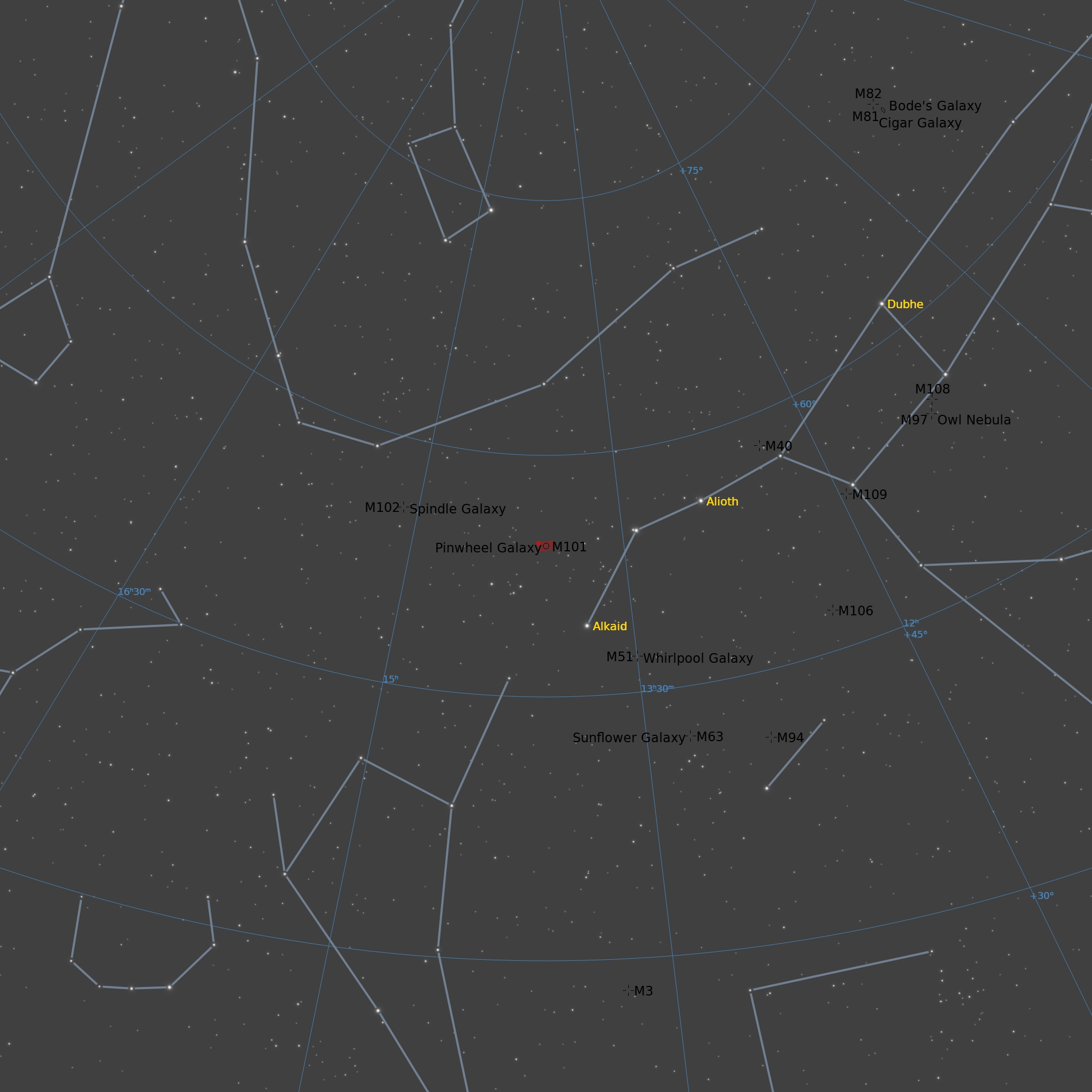
M 101 - 585
DETAILS
Telescope :
Camera :
Mount :
Acquisition :
Integration :
Processed :
Rotation :
RMS Error :
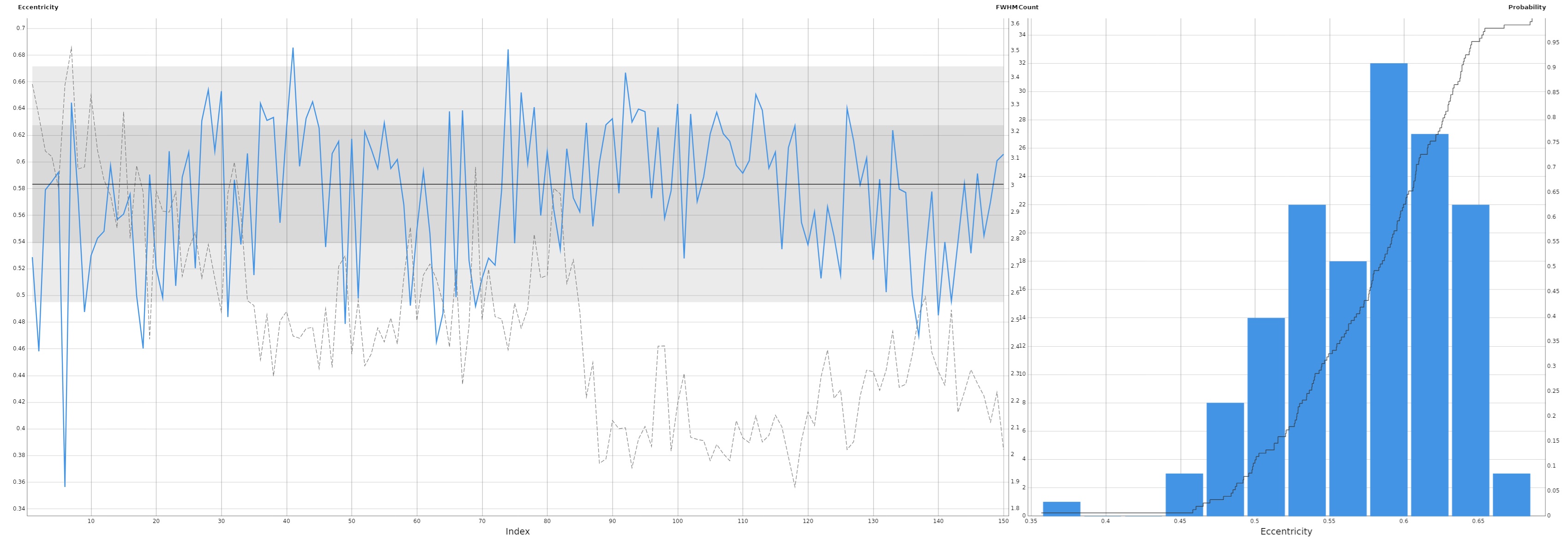
Median FWHM :
Median Eccentricity :
FWHM
NOISE
Askar 103 - 700
ZWO IMX585 Mc Pro
Proxisky UMI 17 S
Apr 7, 2026
5.5 Hours (340x60s)
Pixinsight
90 °
0.5"
2.1 "
0.5
Eccentricity
STARS
History
Messier 101 (M101 / NGC 5457), known as the Pinwheel Galaxy, was discovered by Pierre Méchain and later added to the Messier catalog. It is one of the finest examples of a grand-design spiral galaxy. 4 Located about 24 million light-years away, M101 is an enormous spiral galaxy over 170,000 light-years across—significantly larger than the Milky Way. Although bright overall, its light is spread out, making its spiral arms faint and difficult to see visually. Unlike symmetric spirals, M101 has a noticeably offset core and uneven structure, likely caused by gravitational interactions with nearby companion galaxies. It is the dominant member of the M101 Group, which includes galaxies such as NGC 5474 and NGC 5585. The galaxy is rich in star-forming regions, many of which were cataloged separately (e.g., NGC 5461 and NGC 5471). It has also hosted several supernovae, including the bright SN 2011fe, one of the closest and best-studied Type Ia supernovae in recent times. Visually, M101 appears as a faint, diffuse glow in small telescopes, with hints of structure under dark skies. In astrophotography, however, it reveals a complex and highly detailed spiral pattern, making it one of the most rewarding galaxy targets.
Comments
Back at the site today seems am the only one today. Moon rises very late and is coming low around 02:00. Seeing today is very good around 2". 65% - 85% Aggression using 1 sec exposures. guiding was very good less than 0.5 rms even noticed several periods of 0.3 rms. Managed to sleep most of the night in my car !
ANNOTATION
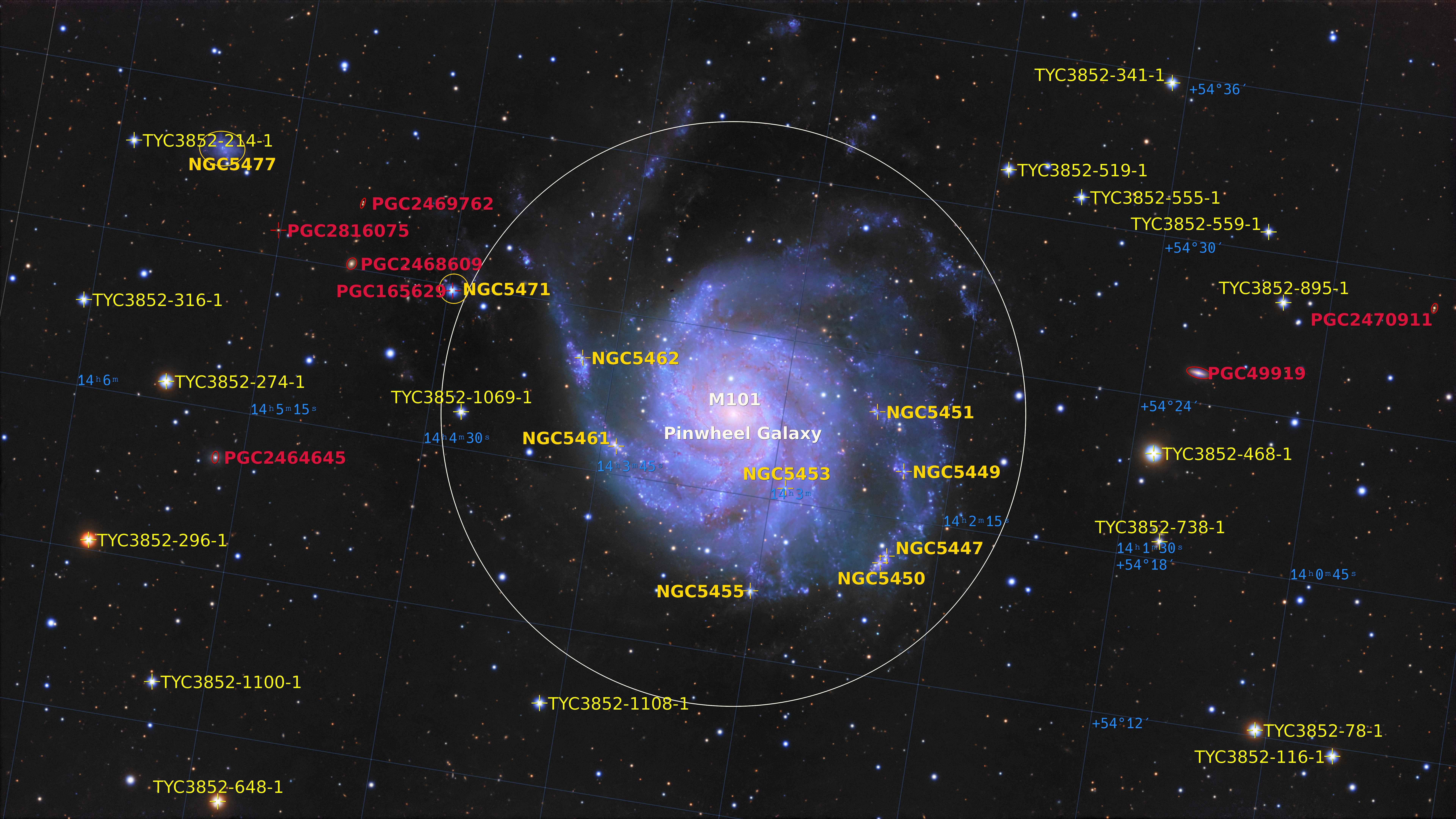
Finder Chart